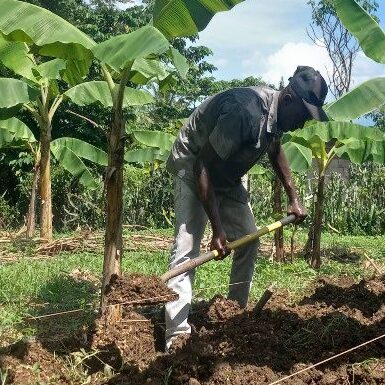
In the fall of 2024, the Le Flambeau Foundation awarded its inaugural Dr. Luc L. Colas scholarships to two students at Université Notre Dame d’Haïti in Cap-Haïtien. These scholarships cover their full tuition for their final two years of college as they pursue degrees in agronomy—a field vital for sustainable development and community empowerment in Haiti. Now, as they completed the first semester of their final Senior year, these students reflect on their journey and share wisdom for the next generation The photo was selected by the scholar, as one that captures their passion.
Below are remarks from scholar Rodné Trevol, as he reflects on his past experience and prepares for his final semester, and college graduation in November 2026.
___________________________
To the Family and Friends of Le Flambeau Foundation ,
I hope you are doing well.
During this first semester of my final year in agronomy, I had an experience that profoundly transformed the way I perceive my future profession. My “Eureka” moment didn’t happen in a classroom, but rather in the field during our practical sessions. Faced with a lack of adequate agricultural equipment, we had to improvise, adapt our methods, and sometimes even slow down our experiments. This situation, though difficult, was extremely educational.
It was at this precise moment that I understood that agronomy in Haiti is not limited to theory; it is, above all, a science of adaptation, resilience, and innovation. Working in sometimes precarious conditions forces us to rethink our approaches and to value the local resources available to us.
This reality taught me an essential lesson: a good agronomist is not just someone who masters technical knowledge, but someone who knows how to apply it effectively in a real—and often constraining—context.
In the face of the many challenges Haiti confronts—notably the lack of agricultural infrastructure, limited access to quality inputs, soil degradation, and the effects of climate change—it becomes indispensable to propose solutions that are adapted, accessible, and sustainable.
To those who will follow this path, I offer this advice: never be discouraged by the limitations of the system. On the contrary, view them as an opportunity to demonstrate creativity and innovation. Haiti needs committed young people capable of transforming constraints into real levers for development.
This semester has also reinforced my vision of a “healthy and sustainable Haiti.” To me, this means a country where agriculture is based on environmentally friendly practices while remaining in line with the socio-economic realities of the producers. It is crucial to promote simple, reproducible, and low-cost techniques in order to strengthen the autonomy of farmers and sustainably improve food security.
As a future agronomist, I feel invested with a mission today: to contribute to building a smarter, more inclusive, and more resilient agriculture. Despite the challenges, I remain convinced that it is through local innovation, continuous training, and the commitment of youth that we will build Haiti’s agricultural future.
Thank you for your attention and your understanding
Rodné Trévol
To read the update provided by our other scholar, Fanequerlie Pierre, click here.
______________________
### How to Get Involved
There are a number of ways to get involved with the Le Flambeau Foundation . As a supporter, you can donate to the foundation, volunteer your time, or become a mentor to a young person in Haiti. Feel free to contact us by clicking here.